
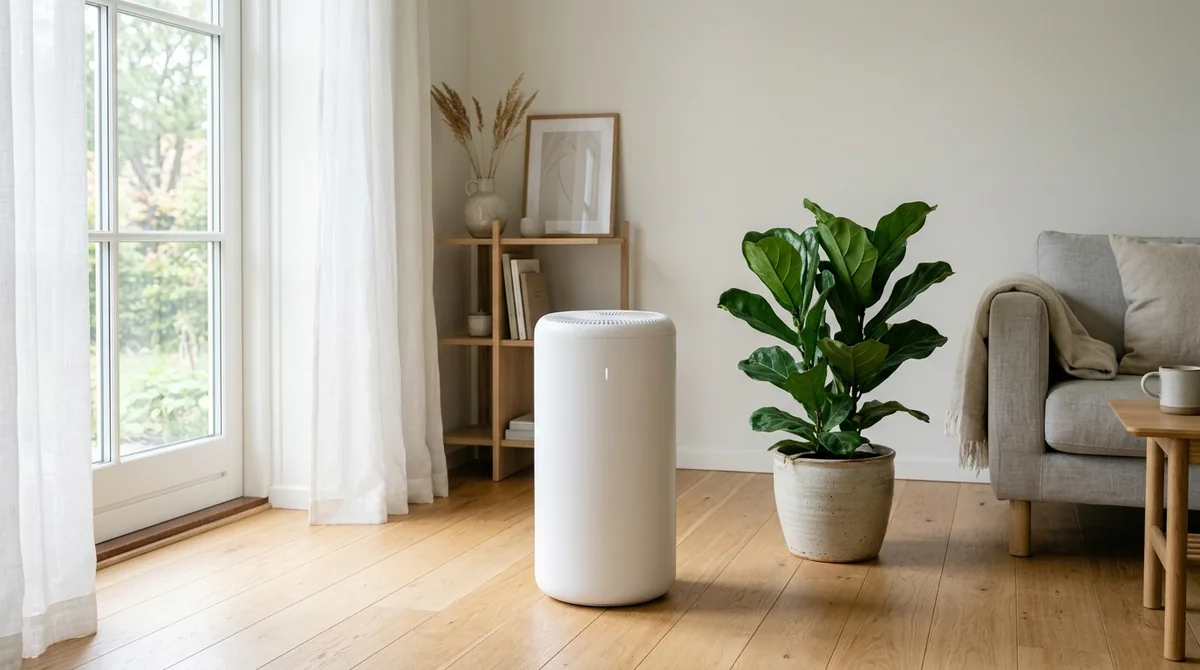
With increasing awareness of indoor particulate pollution, wildfire smoke plumes, airborne allergens, and viral transmission, residential air purifiers have transitioned from niche wellness gadgets into essential household health appliances. However, consumer air purification marketing is filled with misleading terminology: manufacturers advertise vague "purification percentages" (e.g., "99.9% clean air!"), proprietary filter names, and decorative smart displays. Evaluating the real-world effectiveness of an air cleaner requires understanding the standardized metrics of the Clean Air Delivery Rate (CADR) and mechanical filtration physics.
The Definitive Standard: Clean Air Delivery Rate (CADR)
Developed by the Association of Home Appliance Manufacturers (AHAM) and recognized by the EPA and FTC (ANSI/AHAM AC-1), Clean Air Delivery Rate (CADR) measures the cubic feet of clean, particulate-free air produced by the purifier per minute (CFM).
Unlike static filter efficiency ratings, CADR accounts for both:
- The filter's physical capture efficiency.
- The purifier's fan airflow volume.
CADR reports three distinct standardized pollutant categories, reflecting different particle sizes:
- Tobacco Smoke (0.09 to 1.0 microns): The smallest and most dangerous aerosol particles; models wildfire smoke and combustion soot.
- Dust (0.5 to 3.0 microns): Intermediate household particulate matter and mold spores.
- Pollen (5.0 to 11.0 microns): Large biological allergen particles.
| Room Floor Area | Minimum Smoke CADR Needed (2/3 Rule) | ACH Target (Air Changes/Hr) | Recommended Clean Air Volume |
|---|---|---|---|
| 150 sq ft ($14 m^2$) | 100 CFM | 4.8 ACH | High-efficiency small bedroom |
| 300 sq ft ($28 m^2$) | 200 CFM | 4.8 ACH | Standard master suite or home office |
| 450 sq ft ($42 m^2$) | 300 CFM | 4.8 ACH | Open-concept living/dining area |
The Two-Thirds Rule of Room Sizing
To determine whether an air purifier is capable of treating a specific room size, apply the EPA's Two-Thirds Rule: The Smoke CADR rating of the purifier should be at least two-thirds of the room's total floor area in square feet (assuming standard 8-foot ceilings). For a 300-square-foot room, you require a unit with a Smoke CADR of at least 200 CFM.
True HEPA vs. Deceptive "HEPA-Type" Marketing
The term "HEPA" (High Efficiency Particulate Air) is a precise mechanical standard defined by the U.S. Department of Energy (DOE-STD-3020):
- True HEPA: Mechanically certified to capture at least 99.97% of airborne particles as small as 0.3 microns in diameter on a single pass.
- The 0.3-Micron Standard (MPPS): 0.3 microns is not chosen arbitrarily; it represents the Most Penetrating Particle Size. Particles larger than 0.3 microns are easily trapped by impaction and interception, while particles smaller than 0.1 microns are trapped through Brownian diffusion. Capturing 0.3-micron particles represents the absolute physical hardest benchmark.
- "HEPA-Type" or "HEPA-Style": Unregulated marketing buzzwords. These filters are not certified to any international standard and typically capture only 85% to 90% of particulates, allowing fine combustion soot to pass directly back into the room.
The Health Danger of Ionizers and Ozone Generators
Many purifiers advertise "Plasma," "Ionizing," or "Bipolar Needlepoint" technologies. These systems emit an electrostatic charge into the air to clump particles together.
The U.S. EPA and California Air Resources Board (CARB) explicitly warn against consumer air cleaners that utilize unshielded electronic ionization:
- Ionizing mechanisms inevitably produce ozone ($O_3$) as a chemical byproduct of electrical corona discharge.
- Ozone is a toxic pulmonary irritant that oxidizes human lung tissue, exacerbating asthma and inducing chronic coughing.
- When buying an air cleaner, ensure it holds CARB Certification (ozone emissions certified below 0.050 parts per million), or deliberately select purifiers that rely 100% on mechanical filtration without electronic ionization stages.