
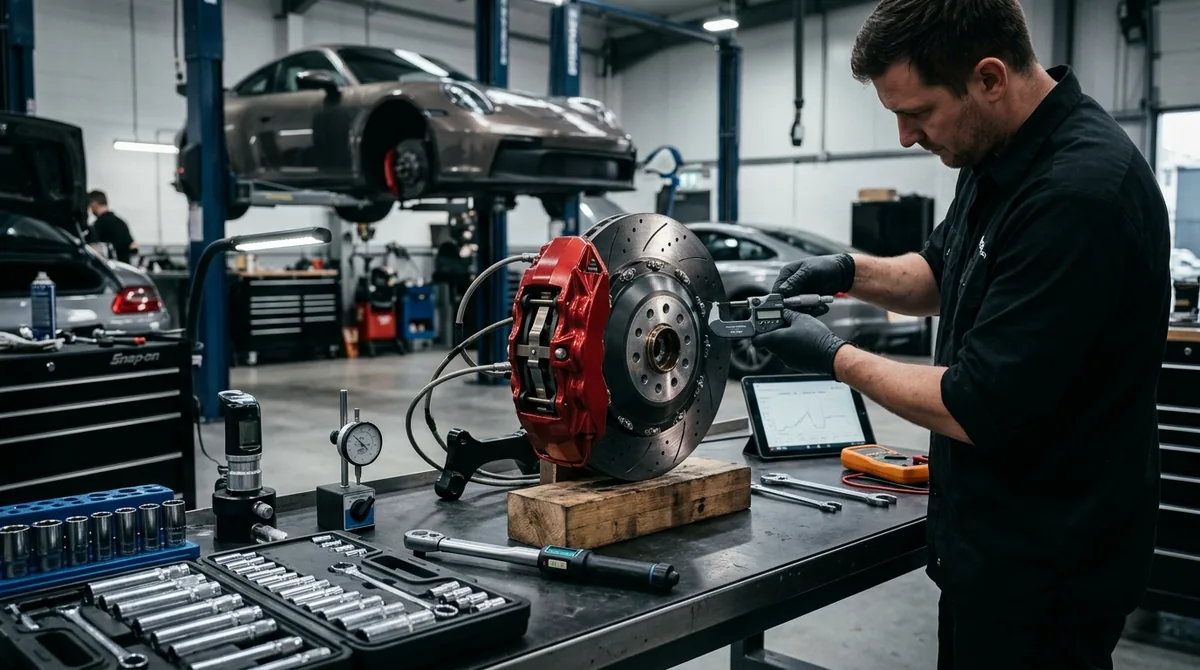
Hydraulic automotive braking systems operate under severe thermal and mechanical stresses. When a driver depresses the brake pedal, mechanical force is amplified by the vacuum booster and master cylinder, transmitting instantaneous hydraulic pressure through non-compressible fluid to the caliper pistons. However, because conventional polyglycol-ether brake fluids are inherently hygroscopic, their chemical integrity degrades over time, creating a latent risk of catastrophic brake fade or total hydraulic failure under sustained descent.
The Chemistry of Hygroscopy: Why Brake Fluid Absorbs Water
Standard DOT 3, DOT 4, and DOT 5.1 formulations are synthesized from polyglycol ether esters and borate esters. Unlike silicone-based DOT 5 fluids, glycol fluids are chemically hygroscopic—they actively draw water vapor directly out of the ambient atmosphere.
Even within an apparently sealed braking system, atmospheric humidity permeates through:
- Microscopic pores in flexible rubber caliper hoses.
- Reservoir cap breather vents and diaphragm seals.
- Master cylinder piston seal sweeps during normal pedal travel.
Over a 24- to 36-month period in temperate climates, hydraulic brake fluid typically absorbs between 2% and 4% water by volume.
Dry Boiling Point vs. Wet Boiling Point
The presence of dissolved water drastically reduces the boiling point of the hydraulic fluid. Standards established by the U.S. Department of Transportation (FMVSS 116) define two statutory thresholds:
- Dry Boiling Point: The boiling temperature of fresh, unadulterated fluid straight from a sealed container.
- Wet Boiling Point: The boiling temperature after the fluid has absorbed approximately 3.7% water by volume (simulating roughly two to three years of real-world road operation).
| Fluid Specification | Base Chemistry | Minimum Dry Boiling Point | Minimum Wet Boiling Point | Key Operational Application |
|---|---|---|---|---|
| DOT 3 | Glycol Ether | 205°C (401°F) | 140°C (284°F) | Standard economy passenger commuter vehicles |
| DOT 4 | Glycol / Borate Ester | 230°C (446°F) | 155°C (311°F) | Modern passenger cars with ABS / ESC systems |
| DOT 5.1 | Borate Ester (Low Viscosity) | 260°C (500°F) | 180°C (356°F) | High-performance vehicles, rapid-cycling ABS |
| DOT 5 | Silicone (Non-Hygroscopic) | 260°C (500°F) | 180°C (356°F) | Classic museum cars; INCOMPATIBLE with ABS systems |
The Physics of Hydraulic Vapor Lock
During prolonged braking—such as descending a steep mountain pass or towing a trailer—friction between the brake rotor and pad generates temperatures exceeding 500°C (932°F). Much of this thermal energy conducts directly through the steel backing plate and caliper piston into the fluid column.
If moisture-degraded fluid exceeds its wet boiling point:
- Dissolved water turns instantaneously into steam vapor bubbles.
- While liquid is incompressible, gas is highly compressible.
- The next pedal application simply compresses the gas bubbles rather than moving the caliper pistons.
- The brake pedal falls flat to the floorboard with zero deceleration—a condition known as hydraulic vapor lock.
Testing and Maintenance Protocols
Brake fluid cannot be judged by visual color alone. Clear or amber fluid can still be saturated with dangerous levels of water.
- Conductivity Test Pens: Cheap resistive testers measure electrical conductivity, but varying additive packages between manufacturers frequently produce false-positive or false-negative readings.
- Boiling Point Testers: The only definitive diagnostic method uses a heated immersion probe that boils a fluid sample in real time, displaying the exact boiling temperature.
- Flush Cadence: Replace brake fluid completely every two years or whenever measured water content exceeds 2.5%, utilizing reverse-pressure or vacuum bleeding equipment to ensure zero air enters ABS modulator valves.