
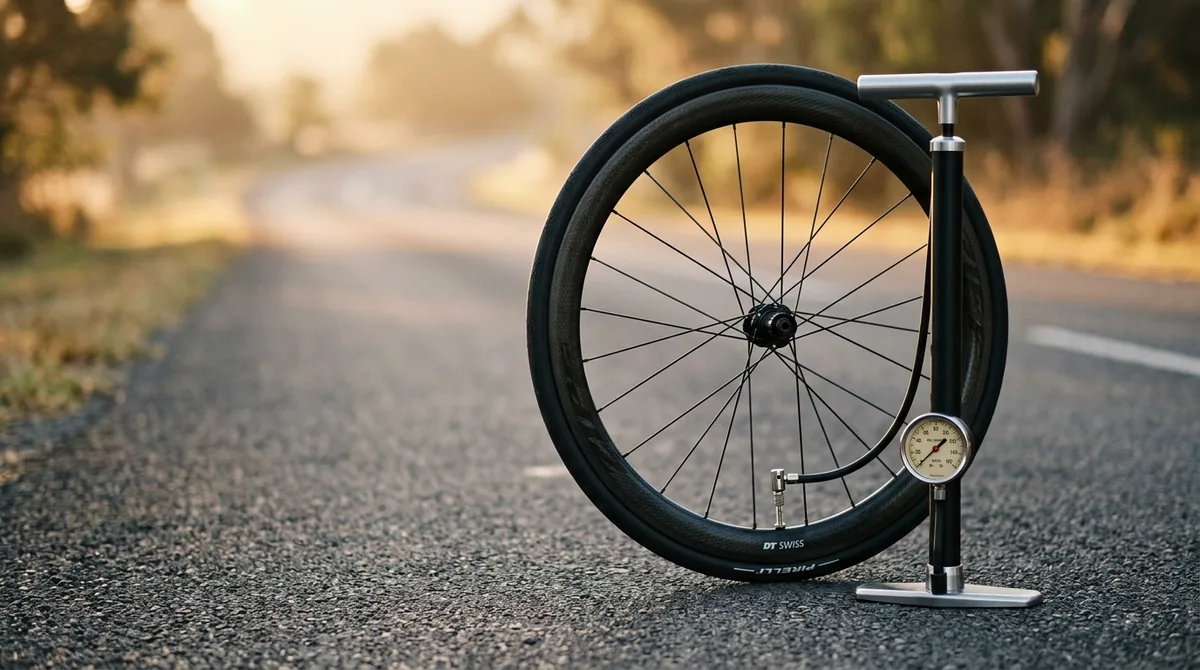
For over a century, road cycling culture held to an unquestioned dogma: narrower tires inflated to maximum rock-hard pressures (110 to 130 PSI / 8 to 9 bar) were faster. Riders believed that rock-hard tires minimized contact patch deformation, allowing the bicycle to glide effortlessly across tarmac. However, modern biomechanical sensor arrays, on-road powermeters, and roller drum testing have completely overturned this assumption. Excessive tire pressure does not make a bicycle faster; on real-world asphalt, it dramatically increases total rolling resistance, elevates rider fatigue, and degrades cornering traction.
The Two Foundational Forces: Hysteresis vs. Impedance
To understand rolling resistance ($C_{rr}$), one must distinguish between two separate physical mechanisms:
1. Hysteretic Damping Loss
As a pneumatic tire rolls, its rubber tread and fabric casing flex and deform under rider weight. The energy required to deform the casing is not returned 100% when the tire rebounds; some mechanical energy is lost as internal heat—a property termed hysteresis. On glass-smooth laboratory steel testing drums, inflating tires to high pressures reduces deformation, thereby reducing hysteretic loss.
2. Vibration Impedance Loss
Real-world roads are not glass-smooth; asphalt consists of microscopic aggregates, cracks, and surface roughness.
- When an over-inflated, rock-hard tire strikes a road irregularity, the tire casing refuses to deform.
- Instead, the entire mass of the bicycle and rider is deflected upward in tiny vertical accelerations.
- Lifting 80 kilograms of rider and bike vertically thousands of times per minute consumes massive mechanical wattage—energy drained directly from your leg muscles that would otherwise propel you forward.
The Silca Impedance Breakpoint
Pioneered by bicycle engineer Josh Poertner, the Impedance Breakpoint demonstrates the non-linear behavior of tire pressure on real road surfaces:
$$\text{Total Resistance} = \text{Hysteresis Losses} + \text{Impedance (Vibration) Losses}$$
- Below the Breakpoint: As pressure increases from low values, rolling resistance decreases predictably because casing hysteretic flexing is reduced.
- At the Breakpoint: Total resistance reaches its absolute lowest point, balancing tire deformation with road vibration absorption.
- Above the Breakpoint (The Cliff): Once pressure exceeds the breakpoint, impedance losses escalate violently. Rolling resistance does not merely level off; it spikes exponentially upward.
| Surface Condition | Typical Tire Width | Old Dogma Pressure | Modern Optimal Pressure | Wattage Saved at 30 km/h |
|---|---|---|---|---|
| Smooth Track / Velodrome | 23 mm | 120 – 140 PSI | 100 – 110 PSI | Baseline |
| Fresh Smooth Asphalt | 28 mm | 100 – 115 PSI | 65 – 75 PSI | 6 – 10 Watts |
| Coarse Chip-Seal Country Road | 28 – 30 mm | 90 – 100 PSI | 55 – 65 PSI | 15 – 22 Watts |
| Hardpack Gravel / Dirt | 40 mm | 50 – 60 PSI | 32 – 38 PSI | 30+ Watts |
A cyclist running 110 PSI on a chip-seal road is easily wasting 15 to 20 watts of aerobic effort purely shaking their own body mass.
Casing Suppleness and Tubeless Architecture
Tire construction plays an equally vital role:
- Thread Count (TPI): Cheap training tires use stiff nylon casings with low thread counts (30 to 60 TPI), requiring thick rubber that exhibits high hysteresis. Premium tires utilize ultra-fine cotton or poly-cotton casings (220 to 320 TPI) that deform effortlessly around road aggregates, lowering rolling resistance.
- Tubeless Systems: Eliminating the internal butyl rubber tube removes a critical source of friction. In traditional clincher tires, the inner tube constantly rubs against the inside of the tire casing as it rolls, dissipating energy. Tubeless systems eliminate this internal shear, allowing lower pressures with zero risk of "pinch flat" snakebites.