
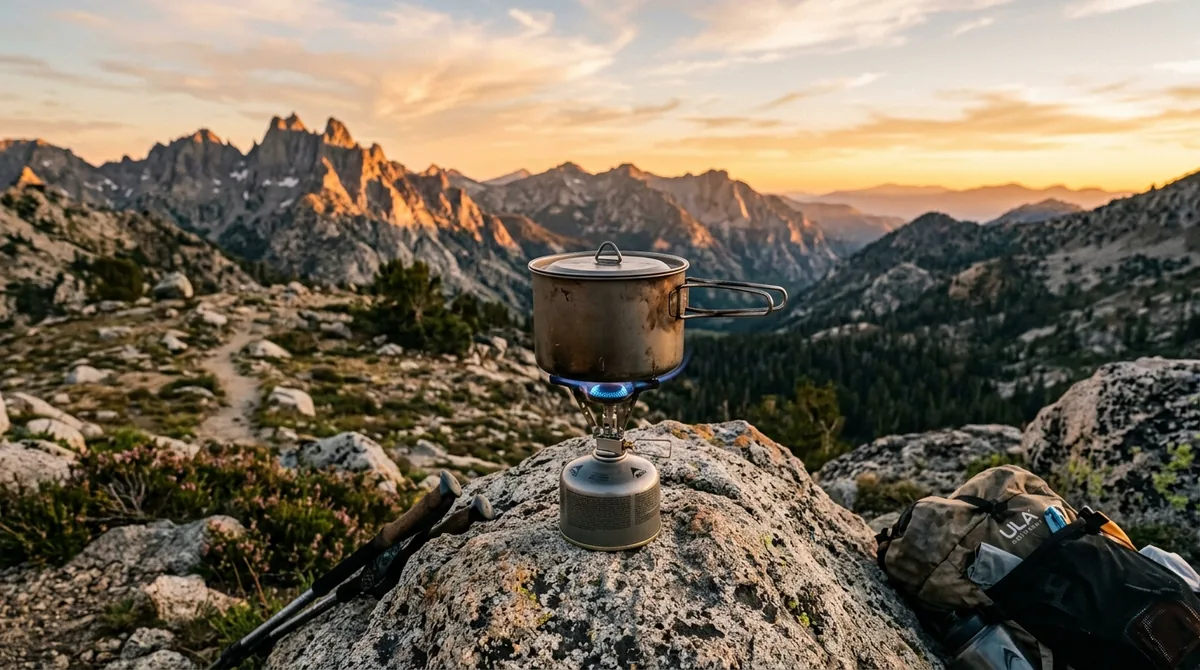
Selecting a backcountry cooking system involves understanding thermodynamics, fuel phase transitions, and convective heat transfer. Outdoor stoves generally divide into two primary architectures: pressurized liquefied petroleum (LP) canister systems and manually pressurized liquid-fuel systems. Each system demonstrates starkly different performance characteristics depending on atmospheric pressure, ambient temperature, and cookware geometry.
Liquefied Gas Thermodynamics: Propane vs. Isobutane
Canister stoves operate on pre-pressurized gas mixtures, typically an 80/20 or 70/30 blend of isobutane and propane. Understanding the boiling points of these chemical fractions explains why canister stoves falter in freezing environments:
- Propane ($C_3H_8$): Boiling point of -42°C (-44°F). Maintains high vapor pressure in extreme cold.
- Isobutane ($C_4H_{10}$): Boiling point of -11.7°C (11°F). Stable vapor pressure down to moderate freezing.
- N-butane ($C_4H_{10}$): Boiling point of -0.5°C (31°F). Ineffective below freezing; common in cheap fuel canisters.
When a standard upright canister stove runs, fuel vaporization absorbs heat from the canister shell—a thermodynamic phenomenon known as evaporative cooling. In ambient temperatures near 0°C, the temperature of the canister can drop well below the boiling point of isobutane. The propane component boils off first, leaving behind cold liquid butane that cannot generate sufficient vapor pressure to sustain combustion.
Liquid White Gas: Reliable High-Output in Extreme Cold
Liquid-fuel stoves utilize refined petroleum naphtha (commonly marketed as white gas). Unlike canister stoves, liquid stoves require manual pressurization via an integrated hand pump and a preheating stage to vaporize the fuel inside a generator tube before it reaches the burner nozzle.
| Parameter | Canister Stove (Upright) | Inverted Canister Stove | White Gas Liquid Stove |
|---|---|---|---|
| Minimum Reliable Temp | -2°C (28°F) | -15°C (5°F) | -40°C (-40°F) |
| Field Maintainability | Very Low (discard canister) | Low (sealed regulator) | High (complete teardown & cleaning) |
| Simmer Control | High (fine needle valve) | Moderate | Low to Moderate |
| Fuel Weight Efficiency | High for trips < 4 days | Moderate | High for prolonged winter trips |
For extended winter mountaineering expeditions, liquid white gas remains the engineering benchmark. The fuel generates consistent heat output regardless of temperature, the bottles are refillable and reusable, and the fuel cost per thermal unit is substantially lower than single-use steel canisters.
Maximizing Thermal Transfer: Heat Exchangers and Wind Screens
Convective wind is the greatest source of heat loss in outdoor cooking. Even a gentle 8 km/h (5 mph) breeze can increase fuel consumption by up to 250% by stripping hot combustion gases away from the pot base before heat transfer occurs.
To optimize stove efficiency:
- Utilize full wind protection: For remote-burner stoves, surround the burner and pot base with a rigid aluminum windscreen. (Never encircle an upright canister stove completely, as excessive thermal buildup can rupture the canister pressure vessel).
- Employ integrated heat exchangers: Cookware featuring welded annular flux rings channels hot perimeter gases directly into the base of the pot, reducing boil times from 4.5 minutes down to 2.2 minutes per liter.
- Keep lids seated securely: Uncovered boiling loses substantial latent heat through surface evaporation; maintaining a tight-fitting lid reduces required fuel by up to 20%.