
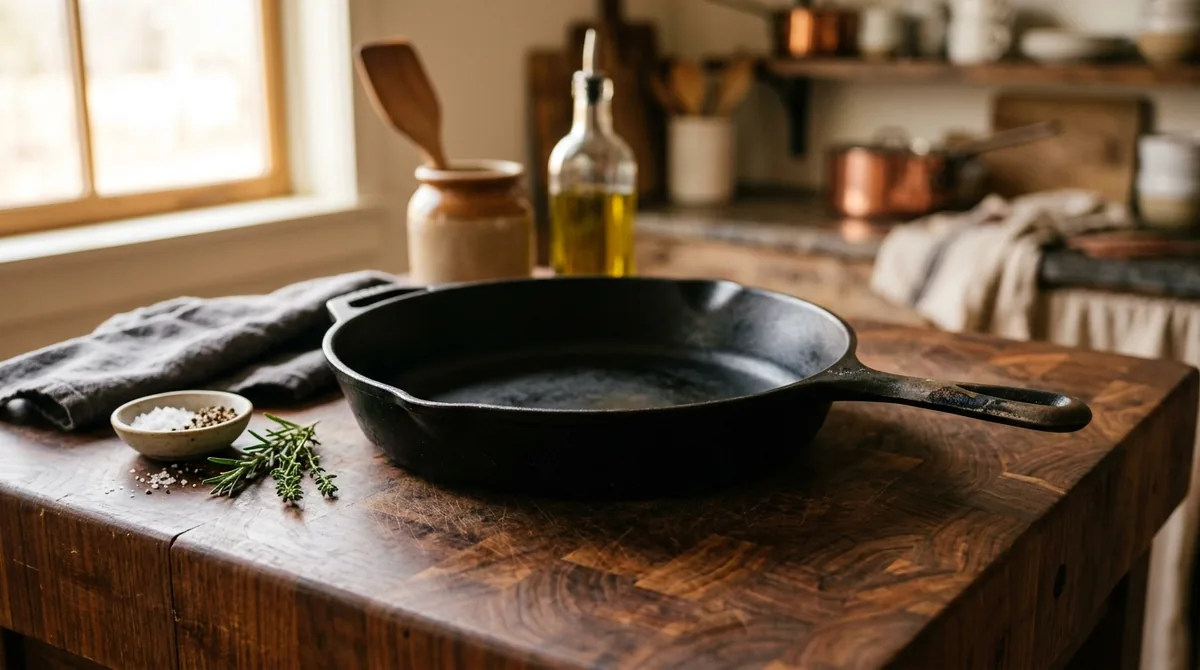
The Chemistry of Culinary Seasoning
Cast iron is an alloy of iron containing approximately 2% to 4% elemental carbon and small percentages of silicon. When cast in sand molds, microscopic pits, peaks, and crystalline voids form across the metallic surface. Unprotected bare iron oxidizes rapidly in the presence of ambient moisture and atmospheric oxygen, yielding hydrated iron(III) oxide (rust, $\text{Fe}_2\text{O}_3 \cdot n\text{H}_2\text{O}$).
A well-seasoned skillet resists corrosion and releases delicate proteins effortlessly. This non-stick characteristic is not achieved by leaving a layer of residual grease on the pan. Instead, seasoning represents an irreversible chemical transformation: the thermal degradation, free-radical autoxidation, and three-dimensional cross-linked polymerization of polyunsaturated fatty acids directly into the microscopic fissures of the metal lattice.
The Three Chemical Stages of Polymerization
The conversion of liquid culinary oil into an insoluble, hard, glassy polymer occurs through three distinct temperature-dependent phases:
1. Thermal Decomposition and Smoke Point Transition
As oil is heated past its smoke point ($200^\circ\text{C}$ to $230^\circ\text{C}$, depending on oil refining), volatile compounds, free fatty acids, and water molecules evaporate. The remaining triglycerides begin thermal breakdown, breaking weak carbon-hydrogen bonds and generating reactive peroxide intermediates and hydroxyl free radicals.
2. Autoxidation and Double-Bond Cleavage
Polyunsaturated fatty acids contain methylene-interrupted double bonds ($-\text{CH}=\text{CH}-\text{CH}_2-\text{CH}=\text{CH}-$). When oxygen from the air mixes with high-temperature oil films, atmospheric oxygen attacks the reactive bis-allylic methylene carbons. This cleavage initiates a cascade reaction, forming conjugated dienes and volatile aldehyde byproducts while propagating reactive alkyl radicals.
3. Radical Cross-Linking and Polymer Network Growth
As heating persists above $230^\circ\text{C}$ ($450^\circ\text{F}$), the activated carbon radical chains link with adjacent fatty acid chains. Rather than flowing as a viscous liquid, the molecules form covalent carbon-carbon bonds, creating a dense, three-dimensional thermoset polymer network. Continued heat induces partial pyrolysis (thermal cracking), depositing sub-micron elemental carbon particles into the polymer matrix. This embedded carbon gives seasoned cast iron its characteristic jet-black luster and exceptional surface hardness.
Molecular Cross-Linking Progression:
[Liquid Triglyceride Film]
      │  + Thermal Energy (> 200°C)
      ▼
[Lipid Peroxide Radicals & Conjugated Dienes]
      │  + Atmospheric Oxygen & Time
      ▼
[Insoluble 3D Cross-Linked Polymeric Matrix]
      │  + Partial Pyrolysis
      ▼
[Durable Carbon-Reinforced Non-Stick Patina]
Selecting the Optimal Seasoning Lipid: Iodine Value
The structural suitability of any cooking oil for seasoning is determined by its Iodine Value (IV)—a standardized laboratory measure of unsaturation representing the grams of iodine consumed by 100 grams of fat. Higher iodine values signify greater concentrations of reactive carbon-carbon double bonds available for oxidative polymerization:
| Oil Type | Predominant Fatty Acid | Typical Iodine Value | Polymerization Speed & Hardness |
|---|---|---|---|
| Flaxseed / Linseed | Alpha-linolenic (Omega-3 polyunsaturated) | 175 – 200 | Very Fast; extremely hard but brittle |
| Grapeseed Oil | Linoleic (Omega-6 polyunsaturated) | 125 – 140 | Fast; balanced elasticity and tough bond |
| Canola / Rapeseed | Oleic (Monounsaturated) + Linoleic | 110 – 120 | Moderate; highly resilient, general-purpose |
| Lard / Animal Fat | Oleic / Palmitic (Saturated/Mono) | 45 – 70 | Slow; soft film, prone to flaking |
| Refined Coconut | Lauric (Saturated) | 8 – 10 | Extremely Poor; will not polymerize |
While food-grade cold-pressed flaxseed oil creates an exceptionally hard polymer glass, its rapid crystallization can make it prone to micro-cracking and flaking if subjected to high thermal shock. Refined grapeseed and canola oils offer an optimal compromise: sufficient polyunsaturation for cross-linking, coupled with enough molecular flexibility to withstand repeated rapid expansion and contraction of the underlying iron substrate.
Practical Protocol for Covalent Adhesion
To build an impervious seasoning patina that withstands stainless steel spatulas and hot soapy water:
- Stripping Contaminants: Remove old gummed rancid grease using hot water and sodium carbonate or gentle lye treatment. The raw iron should appear medium gray.
- Micro-Thin Oil Application: Apply a half-teaspoon of refined grapeseed or canola oil across the entire pan. Wipe it down aggressively with clean cotton cloth until the skillet appears completely dry. Any visible liquid oil beads will pool into soft, sticky, gummy spots rather than forming a hard crystalline sheet.
- Controlled Oven Cure: Place the inverted skillet into a cold oven, raise the temperature to $235^\circ\text{C}$ ($460^\circ\text{F}$), and bake for 60 minutes. Turn off heat and allow the iron to cool gradually inside the oven to room temperature.
- Iterative Thin Layering: Repeat this process 3 to 4 times. Multiple sub-micron cross-linked coats yield far greater tensile strength and chemical resistance than a single thick, unpolymerized glaze.