
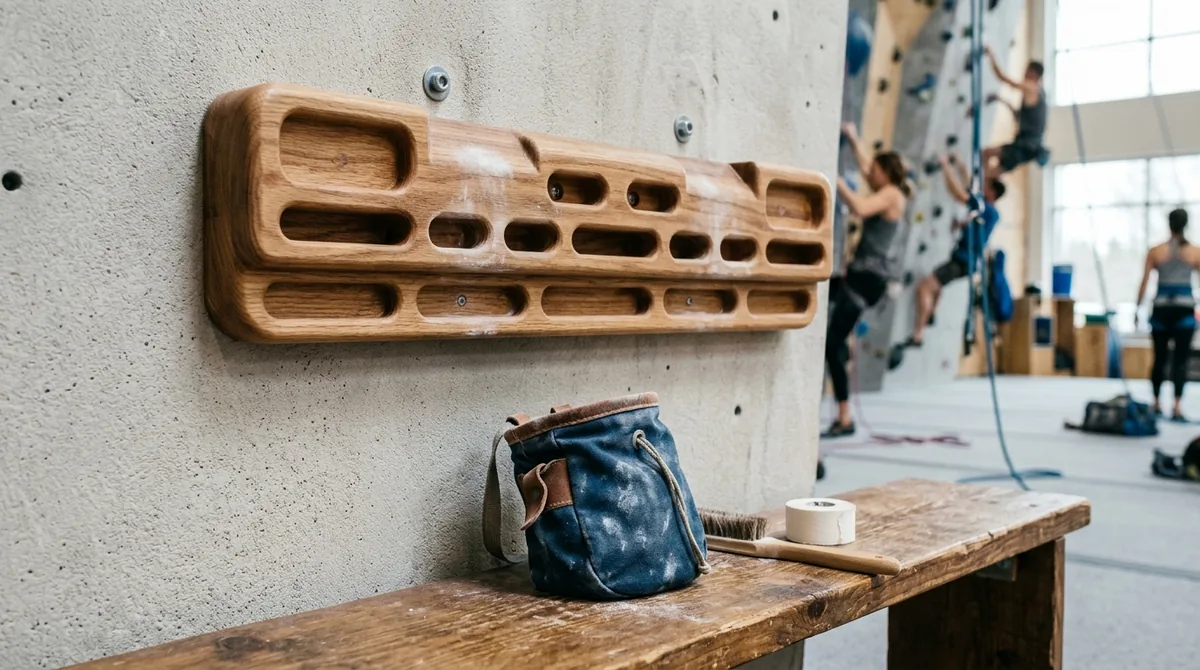
In indoor bouldering and sport climbing, modern route-setting increasingly demands intense physical exertion on micro-edges, flat incuts, and steep overhangs. Because muscular hypertrophy develops far more rapidly than avascular connective tissue remodeling, ambitious climbers frequently subject their finger anatomy to mechanical forces that exceed biological failure thresholds. Among climbing athletes, injuries to the annular finger pulleys—particularly partial tears or complete ruptures of the A2 and A4 pulleys—represent the single most prevalent and protracted musculoskeletal setback.
Functional Anatomy of the Flexor Pulley Mechanism
The human hand contains no muscular tissue within the fingers themselves. Movement is generated by large forearm muscles (flexor digitorum profundus and flexor digitorum superficialis) that connect to finger phalanges via long, dense collagenous flexor tendons.
To prevent these tendons from pulling away from the bone like a bowstring when the finger curls, five fibrous annular ligaments (A1 through A5 pulleys) encircle the tendon, anchoring it tightly against the bone:
- A2 Pulley: Located over the proximal phalanx; the thickest, strongest, and most heavily loaded pulley in the human hand.
- A4 Pulley: Located over the middle phalanx; the second most critical stabilizer.
When a climber applies dynamic body weight to a tiny rock edge, the flexor tendon exerts enormous outward perpendicular force against the inner wall of the A2 pulley sheath.
Biomechanical Comparison: The Full Crimp vs. Open Hand
The magnitude of mechanical strain transmitted into the A2 pulley depends directly on grip architecture:
1. The Full Crimp Grip
The distal interphalangeal (DIP) joint is hyperextended while the proximal interphalangeal (PIP) joint is flexed sharply beyond 90 degrees, with the thumb wrapped tightly over the index fingernail to lock the position.
- Mechanical Advantage: Closes the skeletal kinetic chain, providing immense mechanical purchase on sharp micro-edges (<10 mm).
- Injury Risk: Transmits up to three to four times the actual bodyweight force directly onto the A2 pulley. Under dynamic foot slips, the instantaneous hydraulic force exceeds the tensile yield strength of the collagen fibers, resulting in an audible "pop" and acute pulley rupture.
2. The Open-Hand / Drag Grip
The PIP joint remains straight or gently flexed (less than 45 degrees), with the fingers trailing softly on the hold.
- Pulley Preservation: Tendon deflection angles are minimized, reducing vector forces against the A2 pulley by over 70% compared to a full crimp.
- Training Adaptation: While psychologically less secure for beginner climbers, mastering the open-hand drag builds elite forearm friction strength while shielding connective tissue.
| Grip Technique | PIP Joint Angle | DIP Joint Angle | Relative A2 Pulley Strain | Recommended Usage |
|---|---|---|---|---|
| Full Closed Crimp | Extreme flexion (>90°) | Severe hyperextension | Extreme (300%–400% load) | Competition crux holds only; avoid in daily training |
| Half Crimp | Strict 90° flexion | Flat / Neutral (no thumb) | High (150%–200% load) | Controlled hangboard assessment; intermediate holds |
| Open Hand Drag | Gentle angle (<45°) | Extended | Low (Baseline 100%) | Default training grip for all general climbing |
Connective Tissue Remodeling and Hangboard Protocols
Skeletal muscle tissue enjoys rich capillary blood perfusion, allowing it to adapt and strengthen within 4 to 8 weeks of resistance training. In stark contrast, dense collagenous finger pulleys and tendons have virtually zero direct capillary circulation, relying on passive diffusion of synovial fluid for nutrient delivery.
Connective tissue requires 18 to 24 months of consistent, progressive mechanical loading to achieve significant collagen synthesis and structural thickening.
To safely stimulate pulley remodeling without injury:
- Submaximal Isometric Loading: Utilize a flat wooden hangboard rather than unpredictable dynamic bouldering walls. Controlled hangs isolate loading without unpredictable foot pops.
- The 7-53 Density Protocol: Hang for 7 seconds on a comfortable 20 mm edge at 80% maximum voluntary effort, followed by 53 seconds of complete rest, repeated for 5 sets.
- Progressive Collagen Rest Windows: Tendon collagen synthesis peaks approximately 24 to 36 hours post-loading. Never execute intense crimp training on consecutive days; allow 48 to 72 hours between dedicated fingerboard sessions to allow fibroblasts to lay down new type-I collagen fibrils.