
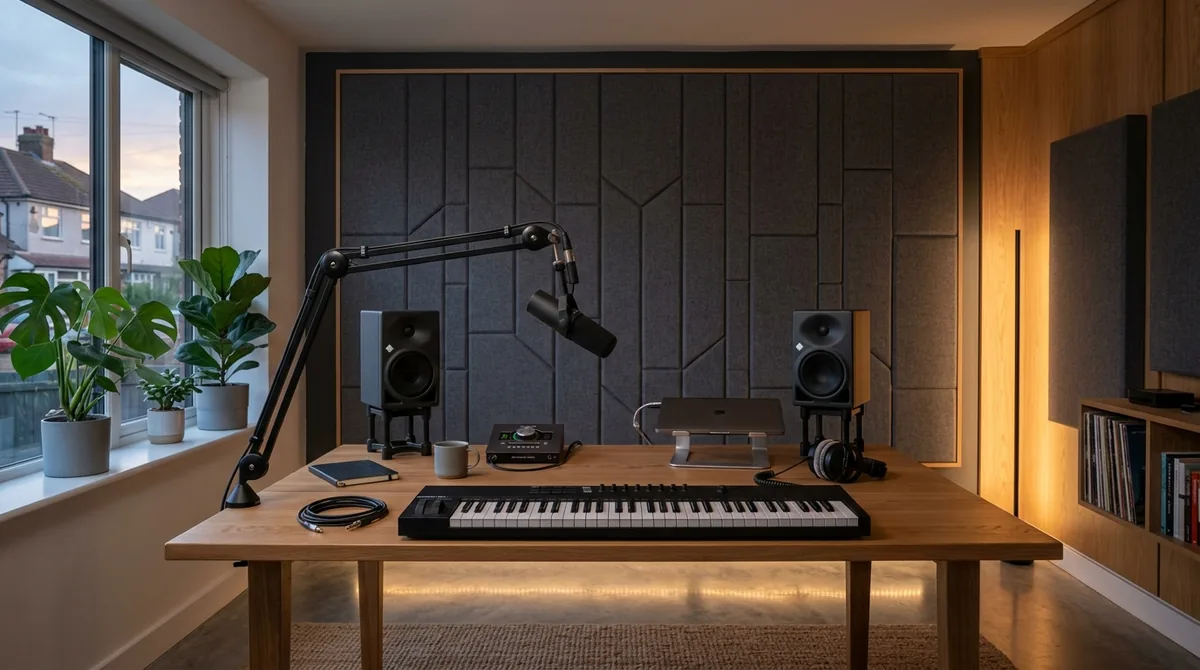
With distributed knowledge workers spending multiple hours daily on video calls, client presentations, and focused cognitive tasks, acoustic control within home office spaces has become a primary productivity factor. Poor audio quality—characterized by room flutter echo, hollow vocal reverberation, and intrusive household noises—causes listener cognitive strain and projects an unprofessional image. Achieving pristine audio requires understanding the fundamental architectural distinction between soundproofing (sound isolation) and acoustic treatment (reverberation control).
Sound Isolation vs. Acoustic Treatment: Two Distinct Physics Problems
The most widespread consumer mistake is purchasing thin foam acoustic panels and expecting them to block noise from children, lawnmowers, or adjacent rooms. Foam panels have zero measurable sound-blocking capability.
1. Sound Isolation (Keeping Noise Out or In)
Governed by the Sound Transmission Class (STC) rating. Sound is acoustic energy that travels through air and building assemblies via mechanical vibrations. Blocking sound requires two physical elements:
- Mass: Dense materials (dense drywall, mass-loaded vinyl, solid-core doors) that resist vibrating in response to airborne sound waves.
- Decoupling and Damping: Physically separating structural surfaces (resilient channels, acoustic clips, Green Glue damping compound) so vibrations cannot transfer directly through framing studs.
2. Acoustic Treatment (Taming Room Reflections)
Governed by the Noise Reduction Coefficient (NRC). Once sound is generated inside the room (such as your voice speaking into a microphone), the waves reflect off hard boundaries (bare drywall, hardwood floors, glass windows), creating flutter echo and muddy room resonances. Acoustic treatment absorbs these reflections to yield a dry, articulate vocal recording.
| Acoustic Goal | Metric | Effective Architectural Interventions | Ineffective Interventions |
|---|---|---|---|
| Block Street / Household Noise | Sound Transmission Class (STC) | Solid-core door, acoustic weatherstripping, double drywall | Egg cartons, thin polyurethane foam |
| Stop Slap Echo on Microphone | Noise Reduction Coefficient (NRC) | 50–100 mm dense mineral wool panels (Owens Corning 703) | Cardboard egg trays, thin tapestries |
| Prevent Low-End Boominess | Bass Trap Absorption (<250 Hz) | Straddling corner broadband porous absorbers | Generic 1-inch pyramid foam tiles |
Sealing the Perimeter: Sound Behaves Like Water
Sound energy leaks through microscopic air gaps with astonishing efficiency. A 1% unsealed air gap in an otherwise solid wall assembly can transmit up to 50% of the total acoustic energy across the barrier.
In a typical residential room, the weakest acoustic link is the door assembly:
- Hollow-Core vs. Solid-Core: Standard residential hollow-core doors provide an STC of approximately 20 to 22. Replacing the door slab with a 45 mm (1.75 inch) solid-core wood or composite door increases the STC to 30–34 immediately.
- Perimeter Perimeter Gasketing: Install heavy-duty neoprene or silicone acoustic seals around the door jamb stop.
- Mortised Automatic Door Bottom: An automatic mechanical drop-down seal that lowers a neoprene gasket flush against the floor threshold when the door latches shut, sealing the massive acoustic gap beneath the door.
Engineering Porous Absorption: Density and Air Gaps
For microphone clarity, you must eliminate high- and mid-frequency reflections. Lightweight polyurethane "acoustic foam" tiles (the common geometric foam sold online) are largely ineffective below 1,000 Hz, leaving mid-frequency vocal "honk" completely untreated.
High-performance absorption utilizes dense semi-rigid mineral wool or fiberglass (such as Owens Corning 703 or Rockwool Safe'n'Sound, density ~45–60 kg/m³):
- Panel Thickness: A 50 mm (2-inch) panel absorbs frequencies down to ~500 Hz. A 100 mm (4-inch) panel provides true broadband absorption down to 125 Hz.
- The Air-Gap Principle: Mount absorption panels with an air gap behind them equal to the thickness of the panel (e.g., a 50 mm panel spaced 50 mm off the wall). Sound waves that pass through the panel reflect off the hard drywall and pass through the absorber a second time, effectively doubling the panel's low-frequency efficiency without additional material cost.