
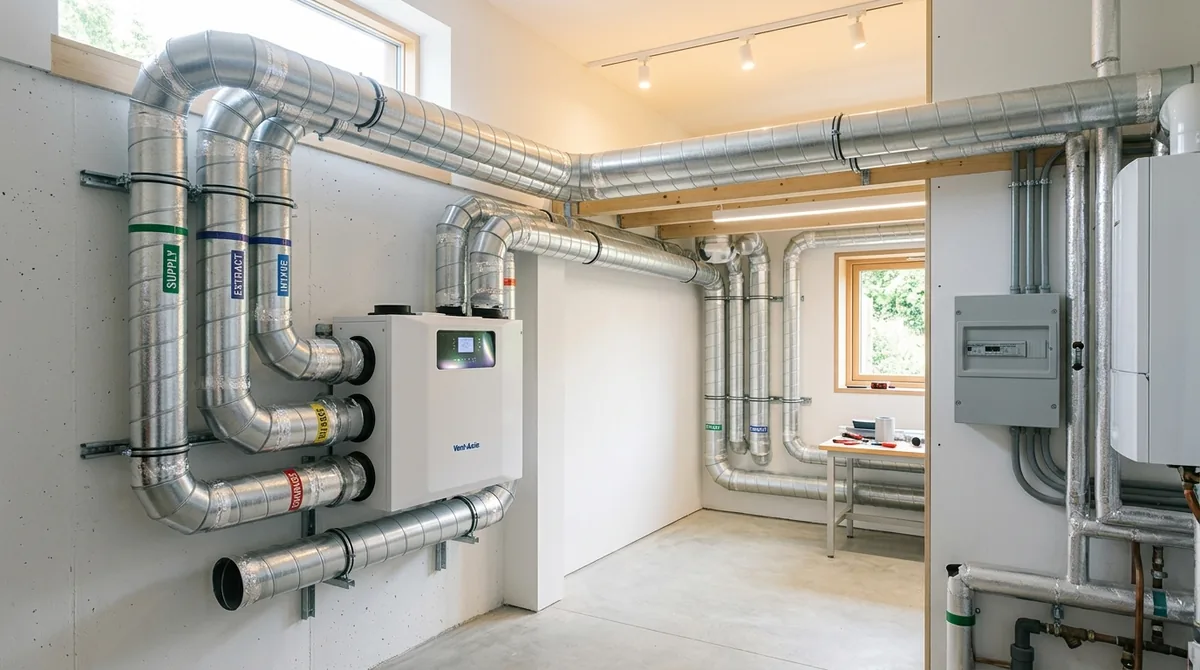
Modern high-performance residential construction emphasizes continuous air barriers, advanced caulking, and high-performance fenestration to eliminate unconditioned air infiltration. While airtight construction drastically slashes heating and cooling energy expenditures, it creates a serious indoor air quality paradox: without natural envelope leakage, indoor contaminants (carbon dioxide, volatile organic compounds, and moisture) accumulate to hazardous concentrations. Continuous mechanical fresh-air ventilation is mandatory, and selecting between a Heat Recovery Ventilator (HRV) and an Energy Recovery Ventilator (ERV) determines system thermal efficiency and seasonal indoor humidity control.
The Aerodynamic Principle of Balanced Ventilation
Exhaust-only ventilation (such as continuous bathroom fans) depressurizes a home, drawing unconditioned, unfiltered air through wall cavities, attic gaps, and crawlspaces. Conversely, supply-only ventilation pressurizes the living volume, forcing humid indoor air into exterior wall framing where it can condense on cold sheathing, causing structural rot.
A balanced mechanical ventilation system utilizes two dedicated ECM fans:
- Exhaust Stream: Extracts stale, humid air from kitchens, bathrooms, and laundry suites.
- Supply Stream: Draws fresh outdoor air, passes it through a high-efficiency media filter (MERV 13 or HEPA), and distributes it to bedrooms and primary living spaces.
- Recovery Core: The two airstreams pass through an internal heat exchanger in adjacent micro-channels without physically mixing, transferring thermal energy across an ultra-thin barrier.
Sensible Heat (HRV) vs. Total Enthalpy (ERV) Transfer
The technical divergence between HRVs and ERVs lies in the physics of moisture transfer:
Heat Recovery Ventilator (HRV)
An HRV transfers only sensible heat (temperature). Its recovery core is manufactured from non-permeable aluminum or polypropylene plates. Warm exhaust air warms the plates, which in turn warm incoming cold winter air. Moisture cannot cross the plastic or metal barrier; water vapor in the exhaust air condenses inside the core and drains out via a dedicated condensate line.
Energy Recovery Ventilator (ERV)
An ERV transfers both sensible heat AND latent heat (moisture vapor). Its recovery core incorporates a permeable polymeric or desiccant-coated membrane. Water vapor molecules diffuse through the membrane from the higher humidity airstream to the lower humidity airstream through osmotic pressure.
| Technical Parameter | Heat Recovery Ventilator (HRV) | Energy Recovery Ventilator (ERV) |
|---|---|---|
| Energy Transfer | Sensible heat only (dry-bulb temperature) | Enthalpy (sensible heat + latent moisture vapor) |
| Core Material | Rigid aluminum or polypropylene plates | Water-vapor permeable desiccant membrane |
| Condensate Drain Required | Yes (mandatory year-round) | Typically no (except in extreme sub-freezing events) |
| Winter Impact on Air | Dries out indoor air aggressively | Retains comfortable 35%–45% relative humidity |
| Summer Impact on AC | Transfers heat, but lets humid air enter | Strips incoming outdoor humidity, reducing AC latent load |
Climate-Driven Equipment Selection
Choosing the incorrect system architecture causes chronic indoor comfort and air quality problems:
- Cold, Dry Northern Climates (Heating Dominated): An ERV is overwhelmingly preferred. In tightly sealed northern homes, continuous winter ventilation with an HRV expels all indoor moisture, driving relative humidity down to an uncomfortable 15%–20%, causing dry skin, sinus irritation, and static shocks. An ERV traps moisture inside during winter while still exhausting VOCs and $CO_2$.
- Hot, Humid Southeastern Climates (Cooling Dominated): An ERV is again optimal. Incoming summer air is hot and heavily saturated with moisture. An ERV transfers outdoor humidity directly into the outgoing exhaust stream before it enters the conditioned space, drastically slashing the latent dehumidification burden on the central air conditioner.
- Cool, Maritime / Rainy Climates (Pacific Northwest): An HRV excels. In regions where outdoor air is cool and persistently damp, homes often suffer from excessive interior moisture. An HRV continuously expels interior humidity without recycling it back into the living space.