
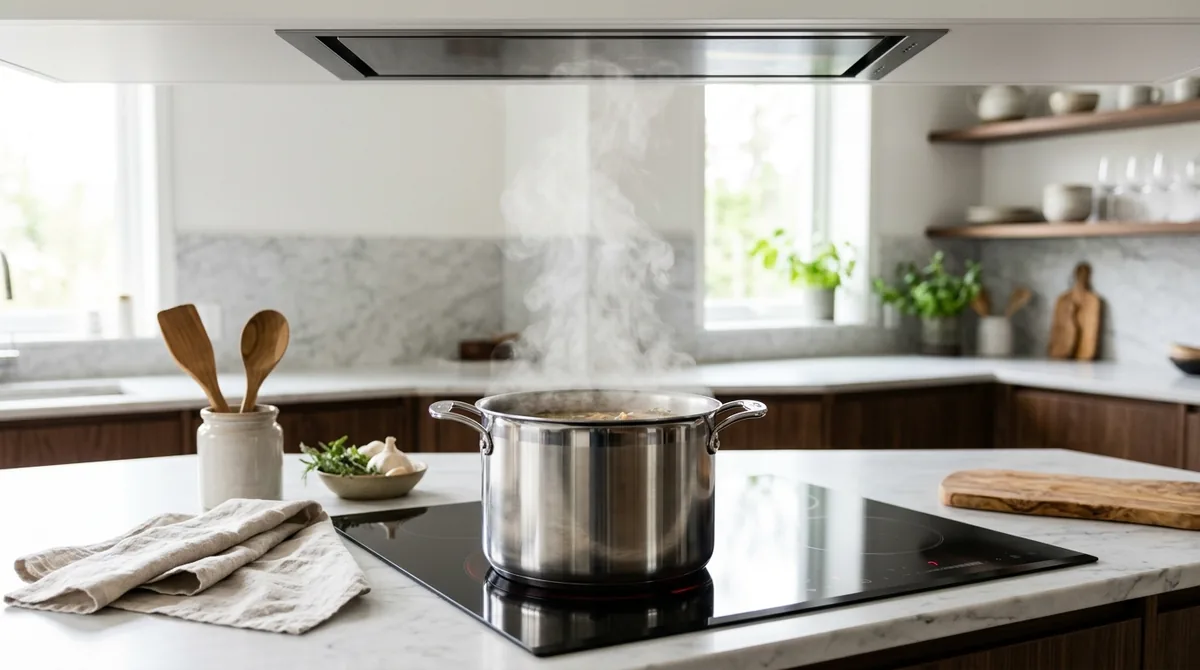
The Environmental Science of Domestic Combustion
For decades, domestic cooking appliances were evaluated almost exclusively on thermal response times, aesthetic appeal, and energy cost per BTU. However, recent advances in high-precision aerosol spectrometry and atmospheric chemistry have shifted scientific focus toward Indoor Air Quality (IAQ).
Modern residential architecture emphasizes building envelope airtightness (measured via blower door tests at $\text{ACH}_{50} \le 1.5$ to $3.0$) to minimize HVAC heating and cooling energy loss. While airtight envelopes deliver exceptional thermal efficiency, they entrap combustion byproducts generated inside living spaces. Unvented or under-vented natural gas cooking appliances represent one of the primary sources of hazardous indoor airborne pollutants in residential buildings.
Primary Combustion Byproducts of Methane Burning
Residential natural gas consists primarily of methane ($\text{CH}_4$, 85% to 95%), with trace amounts of ethane, propane, butane, and odorizing mercaptans. In an ideal thermodynamic stoichiometric environment, methane combustion produces only carbon dioxide and water vapor:
$$\text{CH}_4 + 2\text{O}_2 \longrightarrow \text{CO}_2 + 2\text{H}_2\text{O}$$
In real-world domestic kitchens, however, open atmospheric burners burn gas with uneven flame temperatures, incomplete localized premixing, and turbulent ambient air entrainment. This non-ideal combustion generates three critical pollutants:
1. Nitrogen Dioxide ($\text{NO}_2$)
At gas flame peak temperatures exceeding $1,300^\circ\text{C}$ to $1,800^\circ\text{C}$, atmospheric diatomic nitrogen ($\text{N}_2$) and oxygen ($\text{O}_2$) cleave and recombine via the Zeldovich thermal mechanism to synthesize nitric oxide ($\text{NO}$) and nitrogen dioxide ($\text{NO}_2$), collectively termed $\text{NO}_x$.
- According to studies by Lawrence Berkeley National Laboratory (LBNL), operating a single natural gas cooktop burner and oven for 45 minutes without an active range hood frequently drives indoor $\text{NO}_2$ concentrations above 200 to 400 parts per billion (ppb).
- For context, the World Health Organization (WHO) 1-hour indoor guideline threshold is 100 ppb, while the US EPA outdoor annual ambient standard is 53 ppb.
Indoor NO2 Exposure Comparison:
EPA Outdoor Annual Standard:   █████ 53 ppb
WHO 1-Hour Indoor Limit:       ██████████ 100 ppb
Gas Stove (No Range Hood, 45m):████████████████████████████████ 350+ ppb
2. Carbon Monoxide ($\text{CO}$)
Incomplete combustion resulting from insufficient primary aeration or dirty burner ports produces carbon monoxide. While functioning gas burners typically emit low steady-state CO, yellow-tipping flames or impingement on cold cookware can yield localized spikes exceeding 30 to 50 ppm.
3. Benzene and Volatile Organic Compounds (VOCs)
Research published in Environmental Science & Technology (2022) revealed that unburned natural gas leaking from standard domestic fittings and stove valves contains measurable concentrations of hazardous aromatic hydrocarbons, including benzene—a known Category 1 human carcinogen.
Induction Cooktops: Zero Direct In Situ Emissions
Induction cooktops do not burn fossil fuel. Instead, high-frequency alternating currents (typically 20 kHz to 50 kHz) pass through copper induction coils beneath a ceramic-glass surface, generating an oscillating magnetic field. This field penetrates ferromagnetic cookware, inducing electrical eddy currents and magnetic hysteresis that generate heat directly within the base of the pan itself.
- Zero Chemical Emissions: Because no combustion occurs, induction cooking produces exactly 0.0 ppb of $\text{NO}_2$, carbon monoxide, formaldehyde, or sulfur dioxide.
- Thermal Waste Reduction: Standard gas burners transfer only 35% to 40% of their heat energy into the cooking vessel; the remaining 60% escapes into the kitchen as convective waste heat, driving up summer air conditioning loads. Induction transfers 85% to 90% of its electrical energy directly into food preparation.
Cooking Aerosols: Ultrafine Particles from Food Searing
Transitioning from gas to induction eliminates all appliance-generated combustion gases. However, environmental hygiene engineers emphasize that food preparation itself generates airborne particulates, regardless of heat source:
- High-temperature frying, searing meats, and heating cooking oils past their smoke points produce significant concentrations of Ultrafine Particles ($PM_{2.5}$ and $PM_{0.1}$) and polycyclic aromatic hydrocarbons (PAHs) via fat aerosolization.
- Boiling water on an induction cooktop produces zero particulate matter; searing a steak on cast iron on an induction cooktop generates massive spikes in $PM_{2.5}$.
Ventilation Engineering Recommendations
To maintain healthy indoor air quality across both gas and electric kitchens:
- Ducted Range Hoods Are Mandatory: Recirculating microwave vent hoods equipped with passive charcoal filters do not remove $\text{NO}_2$ or carbon monoxide. Kitchen ventilation systems must exhaust directly outdoors through rigid metal ducting with an airflow rating of at least 300 to 600 CFM (Cubic Feet per Minute).
- Capture Efficiency and Hood Geometry: Turn on the range hood 2 minutes prior to cooking to establish convective draft. Always use back burners when sautéing, as range hood capture efficiency on rear burners ranges from 70% to 85%, compared to 30% to 50% on front burners.
- Dedicated Make-Up Air: In high-efficiency homes equipped with powerful range hoods exceeding 400 CFM, install a motorized make-up air damper interlocked with the hood. Operating a high-CFM exhaust fan in a tight building envelope without make-up air creates negative house depressurization, risking backdrafting of toxic flue gases from water heaters or furnaces.