
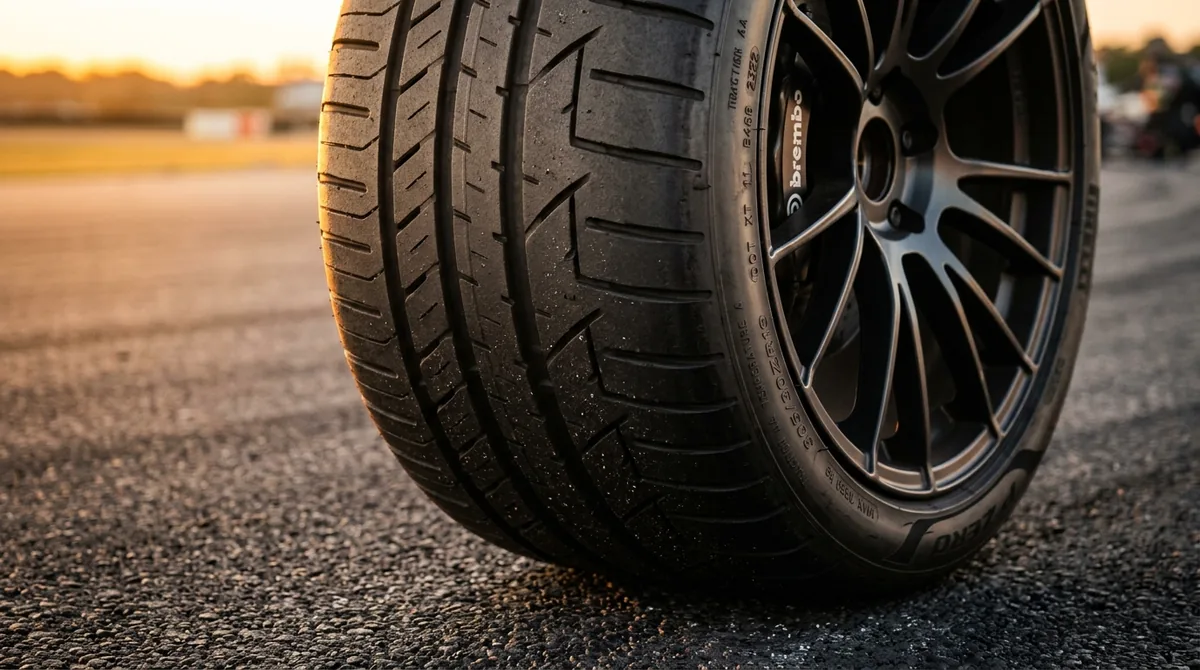
The Structural Hierarchy of Tire Sidewall Markings
Every passenger and commercial vehicle tire sold across regulated international markets features standardized alphanumeric sidewall markings established by the European Tyre and Rim Technical Organisation (ETRTO) and the Tire and Rim Association (TRA). A typical high-performance tire marking appears as:
$$\text{225/45 R 17 94W XL}$$
While vehicle owners readily recognize the dimensional parameters (225 mm section width, 45% aspect ratio, radial construction, and 17-inch rim diameter), the final alphanumeric pairing—94W XL—dictates structural safety margins that determine blowout resistance under load and temperature extremes.
Breakdown of Sidewall Code:
[ 225 ]   /   [ 45 ]       [ R ]       [ 17 ]       [ 94 ]            [ W ]
Width mm    Aspect Ratio   Radial    Rim Inches   Load Index (670 kg)   Speed Rating (270 km/h)
The Load Index: Axle Weight and Inflation Pressure
The Load Index is an assigned numerical code (typically ranging from 75 to 105 for passenger vehicles) representing the maximum mechanical weight an individual tire can safely support when inflated to its maximum rated cold operating pressure:
| Load Index | Max Load (kg) | Max Load (lbs) |
|---|---|---|
| 88 | 560 kg | 1,235 lbs |
| 91 | 615 kg | 1,356 lbs |
| 94 | 670 kg | 1,477 lbs |
| 98 | 750 kg | 1,653 lbs |
| 100 | 800 kg | 1,764 lbs |
| 104 | 900 kg | 1,984 lbs |
To calculate structural suitability, multiply the single tire load capacity by two to determine maximum single-axle support. A vehicle with a front Gross Axle Weight Rating (GAWR) of 1,280 kg requires tires with a minimum load index of 91 ($615 \times 2 = 1,230\text{ kg}$ is insufficient; $670 \times 2 = 1,340\text{ kg}$ with index 94 provides mandatory engineering margin).
Standard Load (SL) vs Extra Load (XL / Reinforced)
- Standard Load (SL): Designed for maximum load capacity reached at a baseline pressure of 35 to 36 psi (2.4 to 2.5 bar). Increasing pressure beyond 36 psi does not increase structural load-carrying capacity.
- Extra Load (XL): Reinforced with heavier internal carcass plies, achieving peak load capacity at 41 to 42 psi (2.8 to 2.9 bar). XL tires are mandatory for modern electric vehicles, which carry massive battery pack curb weights.
The Speed Rating: Thermal Degradation and Centrifugal Distortion
The Speed Rating is represented by a single letter indicating the maximum velocity a tire can maintain over sustained testing intervals without suffering catastrophic tread separation or structural carcass failure:
| Letter Code | Maximum Sustained Speed | Common Application |
|---|---|---|
| S | 180 km/h (112 mph) | Entry-level passenger sedans, utility trailers |
| T | 190 km/h (118 mph) | Family minivans, standard crossovers |
| H | 210 km/h (130 mph) | Sport sedans, touring all-season |
| V | 240 km/h (149 mph) | High-performance sedans, luxury executive |
| W | 270 km/h (168 mph) | Ultra-high performance sports cars |
| Y | 300 km/h (186 mph) | Supercars, high-speed grand tourers |
| (Y) | > 300 km/h (> 186 mph) | Tested under bespoke manufacturer loads |
Speed ratings are not merely legal arbitrary speed limits. In tire laboratory testing (standardized under ISO 10191 and ECE Regulation 30), a tire is mounted on an enclosed drum dyno under 80% to 100% rated load. The rotational speed is increased in 10 km/h increments every 10 minutes until the target threshold is sustained for continuous hours.
The Physics of High-Speed Failure: Standing Waves
When a tire rotates against asphalt, the tread surface deflects inward as it enters the contact patch and springs back as it leaves. At standard city speeds, the elastomeric rubber relaxes instantaneously.
However, as rotational speed approaches critical velocities (exceeding 200 km/h):
- The frequency of rotation exceeds the mechanical relaxation rate of the rubber compound.
- A high-amplitude harmonic deformation called a standing wave forms on the tire casing immediately trailing the contact patch.
- This severe mechanical flexing causes acute internal friction (hysteresis), generating internal temperatures in excess of $140^\circ\text{C}$ ($284^\circ\text{F}$).
- At these temperatures, vulcanized adhesive bonds between steel belts, nylon overlay plies, and the rubber tread matrix break down, leading to rapid tread delamination and catastrophic blowout.
Standing Wave Distortion at High Velocity:
               [ Direction of Rotation ---> ]
               ┌────────────────────────────┐
               │         Tire Casing        │
               └──┐                      ┌──┘
                  │  Standing Wave Ripple│
                  │  (Extreme Heat Gen)  │
                  └───────\/\/\/─────────┘
                      [ Contact Patch ]
High-Speed Load De-Rating
For extreme high-performance applications (ratings V, W, and Y), the tire's rated load capacity decreases progressively as vehicle speed increases beyond specified limits:
- V-Rated Tires: 100% load capacity is maintained up to 210 km/h. Between 210 km/h and 240 km/h, the maximum permissible load capacity is de-rated by 3% for every 10 km/h increase, ending at 91% capacity at 240 km/h.
- W-Rated Tires: Maintain 100% capacity up to 240 km/h, de-rating down to 85% capacity at 270 km/h.
- Y-Rated Tires: Maintain 100% capacity up to 270 km/h, de-rating down to 85% capacity at 300 km/h.
Never fit replacement tires with a lower load index or speed rating than the vehicle's factory OEM homologation placard on the driver-side door jamb. Under-specifying tires voids insurance coverage in many jurisdictions and introduces catastrophic failure risks during summer motorway transit.