
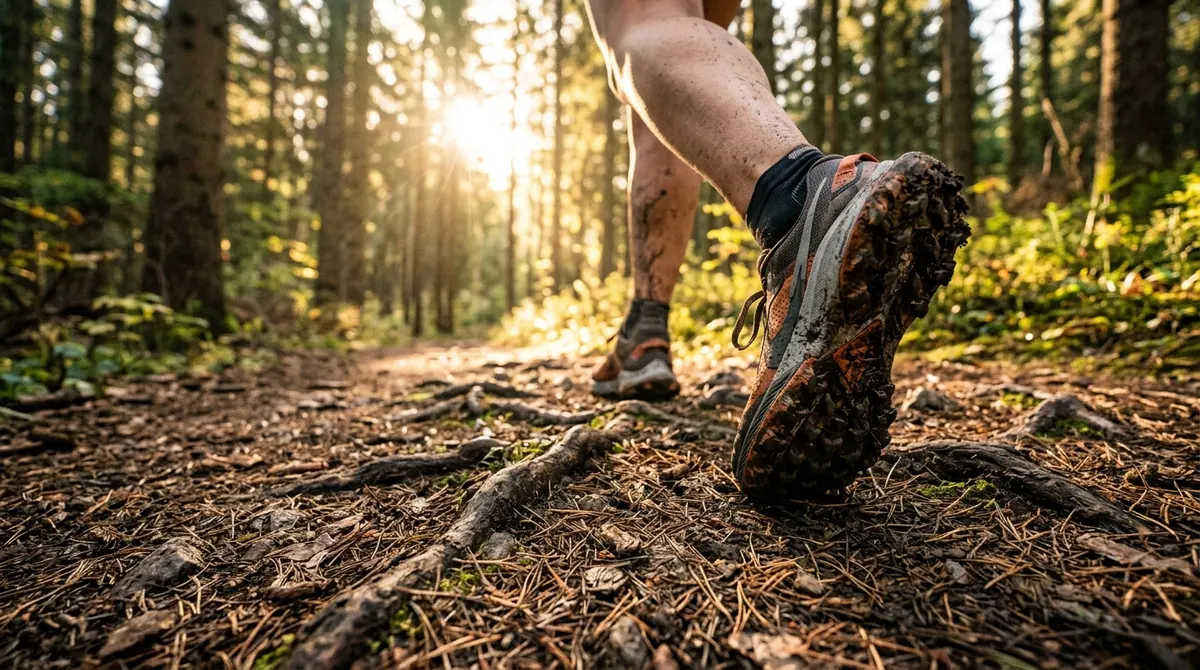
The Kinetic Contrast: Asphalt vs Mountain Terrain
Road running is characterized by uniform, cyclical biomechanics. On flat asphalt or paved running tracks, the surface remains predictable, permitting runners to settle into a steady, repetitive stride length, ground contact time, and vertical oscillation. Energy conservation depends heavily on the stretch-shortening cycle (SSC), where elastic potential energy is stored and returned efficiently through the Achilles tendon and plantar fascia.
Trail running, by contrast, takes place on dynamic, heterogeneous terrain comprising loose scree, wet exposed tree roots, uneven granite boulders, and steep vertical grade fluctuations. Preserving structural joint health and metabolic stamina on rugged trails requires runners to abandon rigid road pacing and dynamically modulate stride mechanics, joint kinematics, and muscular contraction modes.
The Biomechanics of Stride Frequency and Cadence
On variable trails, attempting to maintain the long, low-cadence stride common among road runners introduces severe hazards:
- Overstriding Hazard: Landing with the foot extended far ahead of the body's center of mass forces the knee into near-full extension, dramatically increasing horizontal braking forces and joint shear stress. On loose dirt or wet rock, an overstriding foot easily slips, leading to catastrophic falls.
- High-Cadence Stability: Trail athletes adapt by increasing stride frequency (cadence) to 170 to 185 steps per minute, while significantly shortening stride length. Shorter strides ensure that ground contact occurs directly underneath the center of mass, maximizing friction stability.
- Agility and Micro-Corrections: High cadence shortens Ground Contact Time (GCT) to under 200–250 milliseconds per footstrike. If a rock rolls or a root shifts beneath the shoe, the brief contact duration allows the runner to transfer bodyweight to the contralateral limb before lateral ankle inversion or knee torque can tear ligamentous structures.
+───────────────────────────────────────────────────────────────+
|               Trail Running Kinematic Strategy                |
|                                                               |
|  Ascending (Uphill):                                          |
|  - Forward torso hinge from the hips                          |
|  - Short, rapid forefoot bounding                             |
|  - Shift to Power Hiking when gradient exceeds 12-15%         |
|                                                               |
|  Descending (Downhill):                                       |
|  - High cadence, wide arm balance                             |
|  - Avoid heel-braking; recruit quadriceps eccentrically        |
|  - Land midfoot under center of mass                          |
+───────────────────────────────────────────────────────────────+
Uphill Locomotion: Running vs Power Hiking Economics
When ascending steep mountain trails, runners face a continuous battle against gravitational potential energy ($E_p = mgh$). A classic study by the University of Colorado Boulder Locomotion Lab investigated the metabolic crossover threshold between uphill running and walking:
- The 12% to 15% Gradient Crossover: On moderate grades (under 8% to 10%), running remains metabolically viable for trained athletes. However, as vertical trail gradients steepen beyond 12% to 15% (approx. 7 to 8.5 degrees), the metabolic cost of running increases exponentially compared to walking.
- Power Hiking Mechanics: Elite mountain ultrarunners do not attempt to run steep ascents. Instead, they shift into Power Hiking:
- The torso hinges forward from the hips (maintaining a neutral spine) to align the center of gravity over the lead foot.
- Hands press firmly against the distal quadriceps just above the knee on each step. This kinetic coupling transfers upper body force into the leg, mechanically assisting hip extension and offloading work from the fatigued lower back and gluteus medius.
- Stride lengths shorten to match step rise, while the cadence remains rhythmic and deliberate, keeping heart rate well beneath anaerobic thresholds.
The Destructive Eccentric Forces of Downhill Running
While ascending challenges cardiovascular delivery and aerobic capacity ($VO_2\text{max}$), downhill running poses the greatest threat to muscular integrity and musculoskeletal durability.
During level running, muscles work through a balance of concentric (shortening under tension) and eccentric (lengthening under tension) actions. When running downhill:
- Every footfall drops the body's mass through a vertical distance, multiplying peak impact forces up to 3 to 5 times bodyweight.
- To prevent uncontrolled acceleration, the quadriceps muscle group (rectus femoris, vastus lateralis, and vastus medialis) must contract while simultaneously being forcibly lengthened by knee flexion. This is pure eccentric braking contraction.
- High-load eccentric contractions place immense mechanical strain on individual muscle sarcomeres, causing microscopic tearing of the z-disc structural proteins and triggering severe Delayed Onset Muscle Soreness (DOMS) and systemic creatine kinase spikes.
Downhill Descent Technique
To minimize joint degradation and avoid quadriceps failure on long descents:
- Never Lean Backward (Heel Braking): Leaning back to brake forces the heel to strike hard into the dirt with a locked knee, transmitting immense shockwaves through the patellar tendon, meniscus, and lumbar spine.
- Lean Forward with the Slope: Maintain perpendicular orientation to the terrain slope. Bend the knees to act as active biological shock absorbers.
- Flywheel Cadence: Increase step frequency, taking light, rapid, skimming midfoot steps. Use outstretched arms for lateral angular momentum balance, behaving like a mountain skier navigating technical terrain.
Essential Footwear Considerations for Technical Trails
Running safely on varied surfaces requires specialized trail footwear distinct from road shoes:
- Tread Lug Geometry: Mud, wet clay, and soft loam demand deep, widely spaced 5 mm to 6 mm multidirectional lugs to shed debris; dry hardpack and granite slab require shallower 3 mm to 4 mm sticky vibram/rubber compounds for maximum surface friction.
- Rock Plates (Ballistic Shields): Semi-rigid EVA or carbon composite plates sandwiched between the outsole and midsole distribute point loads from sharp rocks, preventing stone bruising to the metatarsals.
- Toe Bumpers and Lateral Randing: Reinforced thermoplastic polyurethane (TPU) toe caps protect toes from high-impact collisions with hidden roots and granite boulders.