
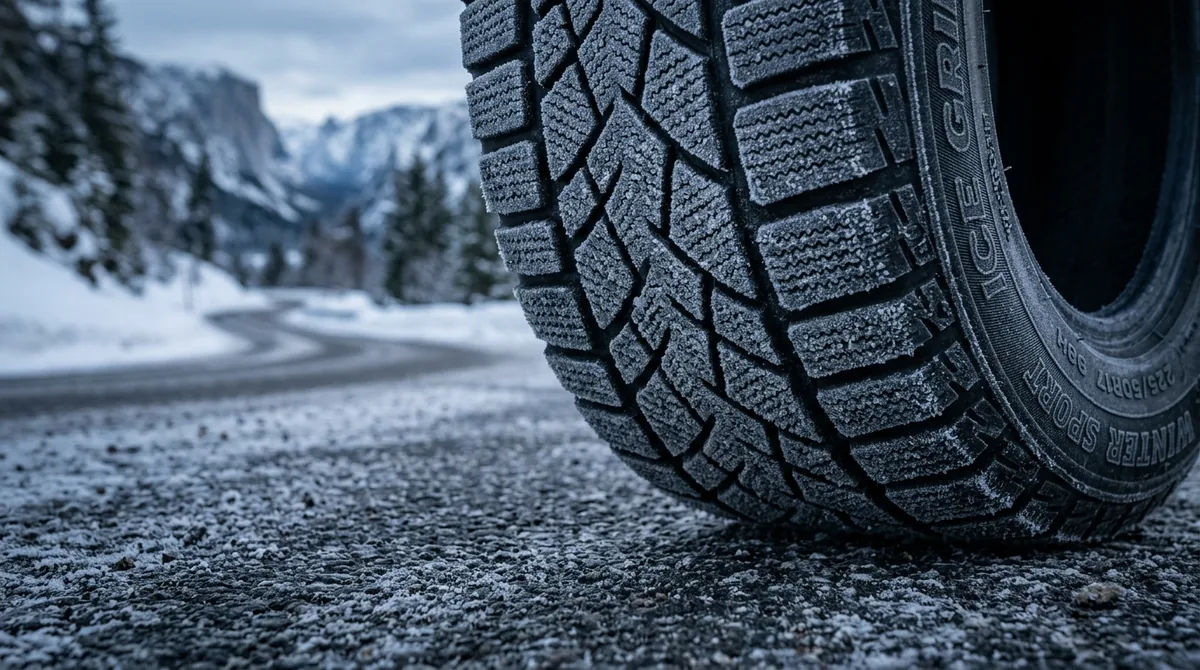
Many motorists believe winter tires are necessary solely when driving on packed snow or glare ice. However, tire performance is fundamentally governed by thermodynamics and polymer chemistry. The standard recommendation to mount winter tires when ambient temperatures consistently drop below 7°C (45°F) is based on the physical properties of rubber compounds, not merely visible road hazards.
1. Rubber Polymers and the Glass Transition Temperature (Tg)
Automotive tire treads are engineered from composite elastomer formulations containing natural rubber, synthetic polymers (polybutadiene and styrene-butadiene), carbon black, and silica.
- Summer and All-Season Compounds: Formulated with a relatively high glass transition temperature. In warm weather, these polymers remain viscoelastic, conforming to the microscopic asperities of asphalt to maximize dry and wet mechanical grip.
- The Hardening Phenomenon: As ambient and pavement temperatures decline toward and below 7°C, summer and standard all-season rubbers approach their glass transition state. The material stiffens, loses compliance, and behaves more like hard plastic. This loss of elasticity prevents the tread blocks from interlocking with road micro-textures.
- Winter Tread Formulations: Winter tires incorporate specialized silica compounds and high percentages of natural rubber with a much lower glass transition temperature. They maintain molecular flexibility down to -30°C and colder, preserving mechanical adhesion.
2. Mechanical Grip: Sipes, Void Ratios, and Hydroplaning
Chemical flexibility is only the first pillar of winter tire performance. The second is physical tread architecture:
| Tread Element | Standard All-Season Tire | Dedicated Winter Tire | Functional Safety Impact |
|---|---|---|---|
| Sipe Density | Sparse linear or wave cuts | High-density 3D interlocking sipes | Multiplies biting edges for shearing ice and snow |
| Void Ratio | Optimized for water evacuation | Wide circumferential and lateral channels | Clears slush, compresses snow-to-snow friction |
| Minimum Tread Depth | 2/32 inch (1.6 mm) legal limit | 5/32 inch (4.0 mm) functional threshold | Channels fail to evacuate slush below 4 mm |
Snow demonstrates higher shear strength against compacted snow than against rubber. Winter tires feature deep lateral grooves engineered to pack snow into the tread, generating snow-on-snow traction during acceleration and emergency deceleration.
3. Practical Replacement and Inspection Guidelines
Maintaining seasonal tires requires adherence to strict operating parameters:
- Mounting in Complete Sets of Four: Never install winter tires exclusively on the drive axle. Unequal grip between front and rear axles induces severe oversteer or understeer during high-speed emergency maneuvers.
- Cold Tire Pressure Monitoring: Tire pressure drops approximately 1 psi for every 5.5°C (10°F) drop in ambient temperature. Regularly inspect inflation using a calibrated gauge when tires are cold.
- Tread Wear Indicators: Dedicated winter tires feature dual wear indicators. When tread wear reaches 4.0 mm (5/32"), the tire loses its severe-service winter certification even if legally usable for dry highway driving.